
Criminal Cases in the Blaine County Courts
Blaine County sits in Idaho's Fifth Judicial District. The District Court is the general-jurisdiction court for felony trials. Its filing counter is in Suite 110 of the Judicial Building in Hailey, and the clerk can be reached at 208-788-5548. The Magistrate Division, in Suite 106, handles misdemeanors, traffic matters, and preliminary felony proceedings. Its public number is 208-788-5521. Idaho has no separate municipal court for Hailey, Ketchum, Bellevue, or Sun Valley, so city citations also enter the Blaine County Magistrate docket.
The filing clerk is the custodian of each court case file. The file begins when a complaint or information is filed, not when a person is booked. It can then collect motions, hearing entries, pleas, orders, a judgment, sentencing terms, and financial entries. A felony may start before a magistrate and later move to District Court. That path is why the court location and case number matter as much as a party name.
Blaine County Court Record Building
The practical destination for Blaine County criminal case records is the Judicial Building at 201 S. 2nd Avenue in Hailey. It is distinct from the Old County Courthouse, which houses county administration, and the Annex Building, which houses the prosecuting attorney. Going to the building named “courthouse” without checking the office can send a requester to the wrong counter.
The Idaho Courts county directory shows the local address and clerk numbers. Its official view helps place the two filing counters in context.
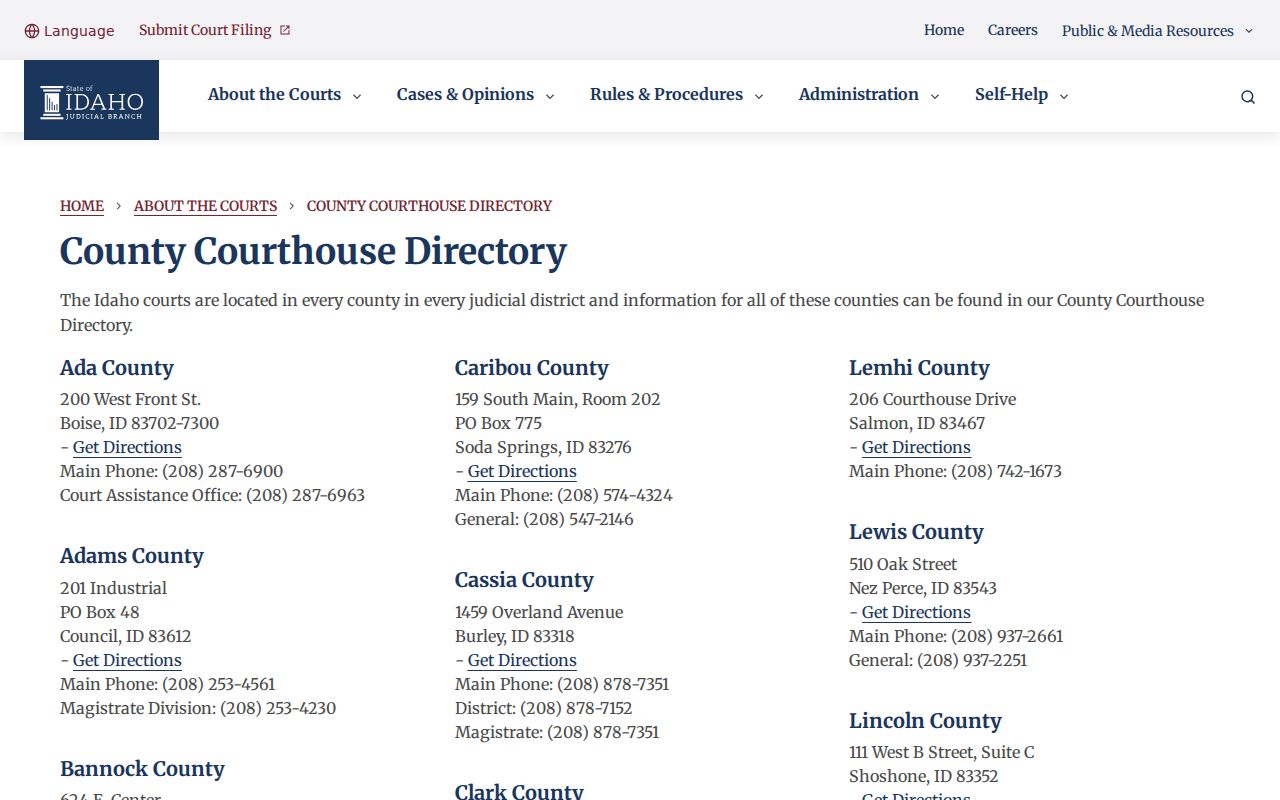
The directory reinforces a useful rule: call the division holding the file before traveling, especially when a docket has moved from a preliminary felony stage to District Court.
How to Search Case Records
The Idaho iCourt Portal is the first public index for Blaine County criminal case records. It can show a case number, court, filing date, status, parties, charges, hearings, disposition, and financial entries when those fields are public. Remote access does not guarantee that the filed document itself can be viewed. Use the courthouse kiosk for fuller on-site access, or ask the correct clerk for a copy or certified copy.
- Open iCourt and choose the public case-search function.
- Use the case or record number when known; otherwise enter a party name.
- Narrow the result by location, case type, status, or filing range when controls are offered.
- Open the docket and compare the court, charges, events, and final disposition.
- Use the Judicial Building kiosk or request the actual filing from the District or Magistrate clerk.
| Field Label | Type | Required | Notes |
|---|---|---|---|
| Last name | Text | For a name search | Check spelling and known former names. |
| First name | Text | No | Add it to narrow common surnames. |
| Case or record number | Text | No | The strongest way to isolate one docket. |
| Location | Selection | No | Narrow results to Blaine County when available. |
| Case type or status | Selection | No | Separate criminal matters and active or closed cases. |
Blaine County iCourt Name Matches
A matching name is not positive identification. Idaho Courts warns that people can share names and birth dates, while aliases can hide or split results. Start with the court location and case number, then compare filing dates and public event details. Do not assume that a search result belongs to a person merely because the spelling matches.
If doubt remains, contact the Blaine County clerk. The clerk can confirm whether a public case number belongs to the right docket, but protected personal identifiers will not be released merely to resolve a guess. A BCI fingerprint self-review answers a different question: it links repository events to fingerprints rather than providing the actual court pleadings.
What the Case File Shows
A Blaine County court file records the prosecution as filed and resolved. The complaint or information identifies the formal charge. Docket entries mark hearings and submissions. Pleas, orders, judgment, sentence, and financial terms show what the court actually did. This is broader than the public index, which may summarize an event without offering the document. It is also distinct from a police narrative and a jail booking record.
| Case Number & Court | Identifies the docket and whether Magistrate or District Court holds it. |
|---|---|
| Charging Document | States the complaint or prosecutor's filed information and counts. |
| Docket Entries | Chronological record of filings, notices, appearances, and orders. |
| Hearing Dates | Lists scheduled and completed court events when public. |
| Disposition & Judgment | Shows dismissal, plea, trial result, and final judgment. |
| Sentence & Conditions | Records custody, probation, restitution, fines, and other ordered terms. |
Blaine County Criminal Case Outcomes
Read the final disposition instead of treating the booking allegation as the answer. A prosecutor may decline to file, amend a count, or dismiss it. A defendant may enter a plea, go to trial, or be acquitted. “Disposition” means the outcome of a charge. A dismissal ends that charge without a conviction, but it does not by itself erase the arrest report, booking entry, or every repository record.
Other terms carry precise meanings. An arraignment is the hearing where the charge is stated and a plea is taken. A withheld judgment is an Idaho form of relief under state law, not automatic expungement. Concurrent sentences run together; consecutive sentences run one after another. The judgment and sentencing order provide the strongest account of the court result.
Stages of a Criminal Case
The prosecutor decides whether and what to file after reviewing the investigation. A misdemeanor stays in the Magistrate Division. A felony begins there for the initial and preliminary stages, then moves to District Court for later felony proceedings. Idaho's local research does not support a fixed promise for how long each stage takes, so use the dated docket events rather than a generic timeline.
Case flow: Charges Filed › Arraignment › Pretrial › Plea or Trial › Disposition › Sentencing
Blaine County Citation Case Routing
City and county citations share the Magistrate Court but do not all follow the same prosecutor route. Proof-of-insurance material tied to a BCSO or Idaho State Police citation goes to the Blaine County Prosecuting Attorney at 219 S. 1st Avenue, Suite 201, Hailey, phone 208-788-5545. Citations issued by Hailey, Ketchum, Sun Valley, or the Bellevue Marshal route to the City Prosecuting Attorney at 101 E. Bullion Street, Unit 2H, Hailey, phone 208-788-7802.
The distinction concerns prosecution and supporting material, not where the court case can be found. Public citation cases still appear through iCourt and the Blaine County Magistrate clerk. If contesting a citation or asking for trial, county instructions direct the reader to call the clerk. Keep the citation number and issuing agency close at hand.
Missing Blaine County Court Documents
An iCourt event can be public even when its underlying filing is not downloadable. First note the case number, court division, document title, and event date. Next, check the courthouse kiosk. If the document still cannot be opened, ask the District or Magistrate filing clerk about inspection, an ordinary copy, or a certified copy.
The clerk must still apply Idaho Court Administrative Rule 32. Presentence reports, sealed records, protected victim or minor data, and confidential assessments are not made public simply because a docket exists. Redaction can also mean that an on-site or copied record has less personal data than a requester expected.
Access & Restrictions
Idaho judicial records are presumptively accessible under Court Administrative Rule 32, but the rule also defines exempt, sealed, and redacted material. Juvenile records receive tighter treatment. Social Security numbers and account details are removed, and presentence reports are presumptively sealed. A case missing from remote results may require a kiosk or clerk check, yet some files remain lawfully unavailable.
The Idaho Public Records Act governs many agency records, but court case access follows the judiciary's own rule. That distinction matters when the same event produced a police report, a booking record, and a court file. The arresting agency decides access to its report; the jail controls custody data; the clerk controls filed court material. For the preceding arrest and booking trail, use the Blaine County arrest history channels.